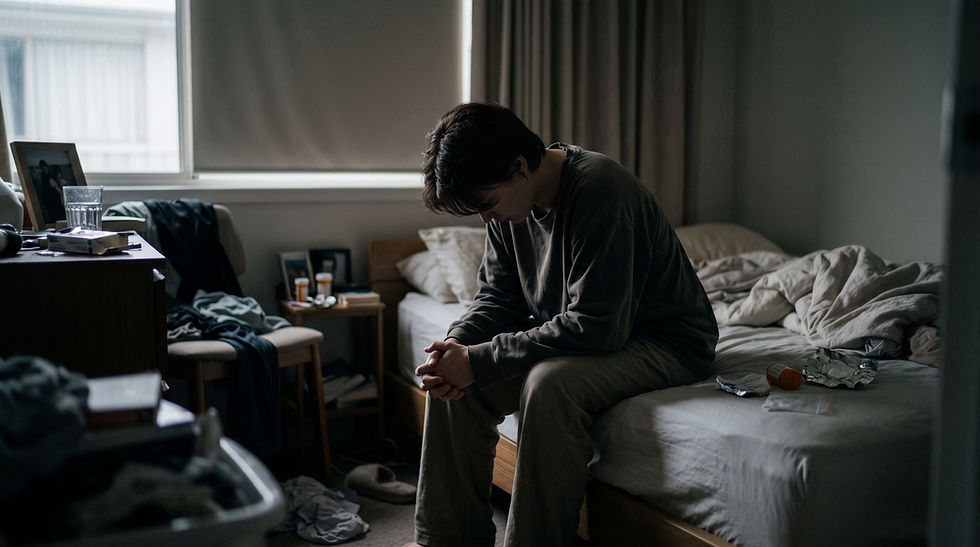
Signs of Dual Diagnosis: How to Recognize Co-Occurring Disorders
Updated: Sep 21

If someone you love is struggling with drinking, drug use, or a mental health condition, you may be noticing changes you can't quite explain. Mood swings that don't match the situation. Withdrawal from people they used to enjoy. A pattern of using alcohol or drugs that seems tied to how they're feeling, not just when they're feeling social.
The signs of dual diagnosis include behavioral changes like withdrawal and risk-taking, emotional shifts like extreme mood swings or hopelessness, and physical symptoms like tolerance and withdrawal. These signs often overlap, which is why co-occurring disorders are commonly missed.
Recognizing dual diagnosis early can change the entire trajectory of someone's recovery. Below, we'll break down the specific behavioral, emotional, and physical signs to watch for, explain why these symptoms are so easy to miss, and cover what integrated treatment actually looks like.
Jump to Section:
What Is Dual Diagnosis?
Signs of Dual Diagnosis: What to Watch For
Why the Signs of Dual Diagnosis Get Missed
Common Dual Diagnosis Combinations
Dual Diagnosis vs. Co-Occurring Disorders
How Chateau Treats Dual Diagnosis
When to Seek Professional Help
Frequently Asked Questions
What Is Dual Diagnosis?
Dual diagnosis describes a mental health condition and a substance use disorder happening in the same person at the same time. According to the National Institute of Mental Health, roughly half of people with a substance use disorder will also experience a co-occurring mental health condition at some point.
Neither condition is "the real one" and the other a side effect. Depression doesn't just happen to cause drinking, and drinking doesn't just happen to cause depression. Both conditions feed each other, which is exactly why they need to be treated together instead of one at a time. Chateau's dual diagnosis treatment program is built around that principle: address both conditions in the same setting, at the same time, with the same clinical team.
The DSM-5 requires at least one substance use disorder and one mental health diagnosis to meet the clinical definition of a co-occurring disorder, according to the American Psychiatric Association's diagnostic criteria. In practice, that combination looks different for every person, which is part of why the signs can be hard to pin down.
Dual diagnosis is common, treatable, and rarely obvious from the outside. That makes it worth knowing exactly what to look for.
Signs of Dual Diagnosis: What to Watch For
The signs of dual diagnosis fall into three general categories: behavioral, emotional, and physical. Rarely does someone show every sign on this list. What matters is a pattern, not a single moment.
Behavioral Signs
Withdrawing from friends, family, or activities they used to care about
Missing work, school, or responsibilities that used to matter to them
Using alcohol or drugs in situations that are clearly risky (driving, mixing substances, using alone)
Doing things that are out of character to keep using, such as lying or borrowing money under false pretenses
Isolating specifically around the times they use, then reappearing once it wears off
These behavioral shifts are often the first thing family members notice, mostly because they're visible. A person who used to answer texts within the hour suddenly goes quiet for days. Someone who never missed a shift starts calling in sick weekly.
Emotional Signs
Mood swings that seem disconnected from what's actually happening around them
Persistent anxiety, sadness, or irritability that doesn't lift
Sudden confidence or grandiosity, followed by a crash
Thoughts of hopelessness, or in more severe cases, thoughts of suicide
Using alcohol or drugs specifically to manage a feeling, not to socialize or unwind
Emotional signs are harder to spot because they live inside the person, not in their calendar. Someone can hide a bad week emotionally in a way they can't hide missing three days of work.
Physical Signs
Developing a tolerance, meaning it takes more of a substance to feel the same effect
Withdrawal symptoms when they stop or cut back, like shakiness, nausea, or sweating
Sleep disruption in either direction: barely sleeping, or sleeping far more than usual
Noticeable changes in appetite or weight
A general sense that they "need" a substance just to function normally
This last point is one of the clearest markers of dual diagnosis specifically. When someone starts using a substance to feel emotionally stable rather than to have a good time, that's usually a sign that a mental health condition and substance use are already tangled together.
If you or someone you love is showing several of these signs at once, particularly across more than one category, it's worth talking to a professional who can screen for both conditions rather than just one.
Why the Signs of Dual Diagnosis Get Missed
Dual diagnosis hides well because its symptoms overlap with dozens of other explanations. Fatigue could be a bad week at work. Irritability could be stress. A drink after a hard day could be nothing. It's the accumulation and the pattern that matter, not any single sign in isolation.
There's also a chicken-and-egg problem clinically. Someone using substances to self-medicate an undiagnosed anxiety disorder may only ever get treated for the substance use, because that's the part everyone can see. Meanwhile, the anxiety keeps driving the behavior underneath it. Treat one without the other, and the untreated condition usually pulls the person back.
This is exactly why the Substance Abuse and Mental Health Services Administration recommends screening for both conditions whenever either one shows up, rather than assuming one explains the other.
Common Dual Diagnosis Combinations
Dual diagnosis can involve almost any pairing of a mental health condition and a substance use disorder, but a few combinations show up often enough to be worth naming directly:
Depression paired with alcohol use disorder
Anxiety disorders paired with stimulant or cocaine use
PTSD and trauma paired with alcohol or opioid use, particularly among first responders and veterans
Bipolar disorder paired with methamphetamine use
Recognizing which combination applies matters clinically. The signs of dual diagnosis in someone using alcohol to numb depression look different from the signs in someone using stimulants to manage the low energy that comes with an untreated mood disorder. A trauma-informed approach to PTSD and addiction treats that connection directly instead of separately.
Dual Diagnosis vs. Co-Occurring Disorders
These two terms get used interchangeably, and in most everyday conversations that's fine. Clinically, "co-occurring disorders" specifically refers to a substance use disorder paired with a mental health disorder. "Dual diagnosis" is the broader term and can technically apply to any two conditions affecting a person at once, though in behavioral health it's used the same way almost all of the time.
If you want the full breakdown of where the terms diverge and why some facilities and insurers use one over the other, our guide on dual diagnosis vs. co-occurring disorders covers it in depth.
How Chateau Treats Dual Diagnosis
Chateau Health & Wellness treats dual diagnosis as one condition with two parts, not two separate problems on two separate timelines. Every client works with a team that addresses substance use and mental health at the same time, in the same 56-bed setting, with one staff member for every four clients.
Integrated treatment at Chateau typically includes:
Individual therapy targeting both the mental health condition and the substance use pattern together
Medication management for conditions like depression, anxiety, or PTSD, where appropriate
Group therapy that addresses the interaction between mental health and addiction, not just addiction alone
Integrated on-site medical detox, so clients don't need to transfer facilities between detox and residential care
30, 60, and 90-day program lengths depending on the complexity of the co-occurring conditions
Treating both conditions in the same setting matters because they don't take turns. A person's anxiety doesn't pause while their addiction gets treated, and cravings don't pause while depression gets treated. Chateau's model exists because separating the two rarely holds up once someone goes home.
When to Seek Professional Help
Noticing one or two signs from the list above doesn't necessarily mean someone has a dual diagnosis. But when behavioral, emotional, and physical signs show up together and persist for weeks rather than days, self-help strategies and willpower alone are rarely enough. That's the point where a professional screening for both conditions, not just one, becomes the next right step.
At Chateau Health & Wellness, we provide integrated dual diagnosis residential care in a private, boutique setting in Utah's Wasatch Mountains.
Frequently Asked Questions
What are the earliest signs of dual diagnosis?
The earliest signs are often behavioral: withdrawing from people, missing responsibilities, or using alcohol or drugs to manage a specific feeling rather than to socialize. These changes are usually gradual at first, which is exactly why family members tend to dismiss them for weeks or months before raising a concern.
Can dual diagnosis be treated if the person doesn't know which condition came first?
Yes. Treatment doesn't require knowing which condition started first. Integrated treatment addresses both the substance use and the mental health condition at the same time, regardless of the order they developed in, since both are actively reinforcing each other by the time someone seeks help.
Is dual diagnosis the same as being "high functioning" with an addiction?
No. Someone can function at work, maintain relationships, and meet daily responsibilities while still meeting the clinical criteria for dual diagnosis. High functioning describes how well someone hides the signs from others, not whether the underlying mental health and substance use conditions are actually present.
How is dual diagnosis diagnosed?
A licensed clinician diagnoses dual diagnosis through a full clinical assessment that screens for both substance use disorders and mental health conditions at once. This matters because one condition is often missed entirely if a provider only evaluates the other in isolation.
Does insurance cover dual diagnosis treatment?
Most major insurance plans cover residential dual diagnosis treatment, including integrated care that addresses both conditions in one program. Chateau's admissions team verifies benefits directly with the insurance provider before a client commits to anything, so cost concerns get resolved early.
Chateau Health & Wellness treats dual diagnosis through fully integrated residential care for adults 26 and older, with medical detox, individual and group therapy, and one staff member for every four clients available on-site. Reach out to Chateau's admissions team or call (801) 877-1272 to talk through what treatment could look like for you or someone you love.





About The Author

Ben Pearson, LCSW - Clinical Director
With 19 years of experience, Ben Pearson specializes in adolescent and family therapy, de-escalation, and high-risk interventions. As a former Clinical Director of an intensive outpatient program, he played a key role in clinical interventions and group therapy. With 15+ years in wilderness treatment and over a decade as a clinician, Ben has helped countless individuals and families navigate mental health and recovery challenges.