
First Responder Mental Health Support: Programs, Training, and Resources That Work
Updated: Sep 25

A shift ends, but the images from the call do not. For police officers, firefighters, paramedics, dispatchers, and corrections staff, that gap between clocking out and the mind catching up is exactly where mental health support has to start.
First responder mental health support means access to trauma-informed counseling, peer support groups, resilience training, and crisis intervention designed around the demands of emergency response work.
This guide breaks down what a real support system includes, how resilience training differs from crisis intervention, and where to find the specific resource that matches what you are dealing with right now.
In this article:
What First Responder Mental Health Support Actually Covers
Why So Many First Responders Wait Too Long to Ask for Help
The Core Components of a Mental Health Program
Resilience Training vs. Crisis Intervention
Find the Right Resource for Your Situation
What Leadership and Department Culture Can Change
How Chateau Approaches First Responder Mental Health
When to Seek Professional Help
Frequently Asked Questions
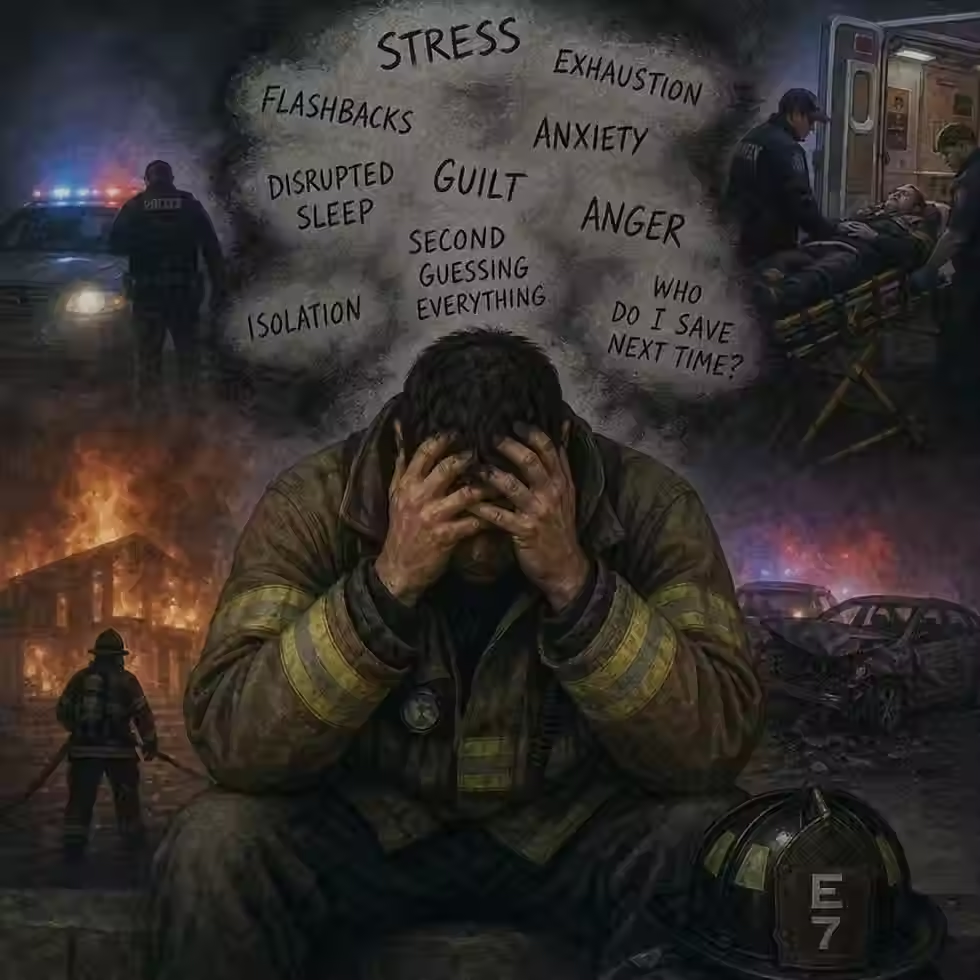
What First Responder Mental Health Support Actually Covers
"Mental health support" gets used loosely. For someone in the field, it needs to mean something specific: a counselor who understands shift work and chain of command, a peer who has worked the same calls, and a plan for the night a call will not leave your head.
Real support usually includes four pieces. Counseling from clinicians trained in occupational trauma. Peer support groups run by people who have done the job. Stress management and resilience training. Crisis intervention for moments that cannot wait for a scheduled appointment.
Confidentiality is not a nice-to-have here. It is the difference between someone calling for help and someone deciding the risk to their career is not worth it.
Departments that get this right build support around all four pieces, not just one. A single wellness seminar a year does not cover what a 3 a.m. call does to someone's sleep for the next six months.

Why So Many First Responders Wait Too Long to Ask for Help
Roughly 30 percent of first responders develop a behavioral health condition, compared to 20 percent in the general population, according to SAMHSA. PTSD, anxiety, depression, and burnout show up most often, and they rarely show up alone.
The delay is not usually about not knowing the symptoms. Most first responders can describe hypervigilance, disrupted sleep, or emotional numbness in detail. The delay comes from fear: fear of being pulled from duty, fear of a promotion getting quietly shelved, fear of being seen as the person who could not handle it.
That fear is not irrational. It is built on real department cultures that reward stoicism and treat help-seeking as a liability. Changing that takes more than a poster in the break room.
Two things move the needle: leadership that talks openly about its own struggles, and confidential care that genuinely sits outside the chain of command. Without both, awareness campaigns tend to raise guilt more than they raise help-seeking.
The Core Components of a First Responder Mental Health Program
A program built for the general public rarely fits someone who carries a badge or a radio. The components below are what separates a program that gets used from one that sits in an employee handbook.
Counseling. Individual therapy with a clinician trained in first responder culture, not just trauma in general. The difference matters. A therapist who does not know what a "code" call means will spend the first three sessions on vocabulary instead of treatment.
Peer support groups. Structured groups led by trained peers who have worked the job. Shared experience does something clinical language cannot: it removes the burden of explaining what a scene was like to someone who was not there.
Stress management and resilience training. Practical skills for regulating the nervous system between calls, not just after a critical incident. This includes breathing techniques, sleep protocols, and cognitive reframing built for high-stress schedules.
Crisis intervention. Immediate response for acute distress, including 24/7 hotlines and rapid access to a clinician. This is the piece that prevents a bad week from becoming a crisis.
The strongest programs coordinate all four across departments and agencies instead of running them in isolation. A police department's peer support team and a fire department's EAP working from the same referral network catches more people than either working alone.

Resilience Training vs. Crisis Intervention: Knowing the Difference
These two get confused constantly, and the confusion has real consequences. First Responder Resilience training is preventive. It builds the mental toughness and coping skills that make the next traumatic call easier to process. It covers stress reduction techniques, emotional regulation, positive reframing, and problem-solving under pressure.
Crisis intervention is reactive. It is what happens after a critical incident, a suicide of a colleague, or a call that hits too close to home. It requires trained personnel who can assess risk immediately and connect someone to care within hours, not weeks.
A department that only offers resilience training has nothing in place for the officer who is actively struggling tonight. A department that only offers crisis response is always managing emergencies instead of preventing them. Both need to exist side by side.

Find the Right Resource for Your Situation
Not every first responder needs the same thing. Below is a directory organized by what you might actually be dealing with right now, drawn from Chateau's full library of first responder guides.
By role
By what you're experiencing
For families and departments
Background reading
If you are not sure where to start, the peer support and resiliency training programs are usually the right entry point. They carry the least stigma and the fastest path to another person who understands the job.

What Leadership and Department Culture Can Change
A single supervisor can undo months of wellness programming, or reinforce it, depending on how they talk about mental health. Leadership sets the tone for whether asking for help reads as weakness or as basic maintenance.
Departments that see real participation in mental health programs tend to do three things consistently: leaders speak openly about their own struggles, mental health training gets refreshed instead of run once and forgotten, and access to care is genuinely confidential, not routed through a supervisor's desk.
None of this requires an unlimited budget. It requires a decision from the top that mental health is treated as part of fitness for duty, not a separate program bolted on to satisfy a policy requirement.
How Chateau Approaches First Responder Mental Health
At Chateau Health & Wellness, first responder care is built around people who have done the job. Our first responder program covers police, fire, EMS, dispatch, corrections, and military service, and our clinical team includes staff with firsthand experience in each of those fields, so sessions start with treatment instead of vocabulary lessons.
Care happens in our 56-bed first responder residential program in Utah's Wasatch Mountains, with
one staff member for every four clients in small, dedicated groups and integrated medical detox on-site when it is needed. Programs run 30, 60, or 90 days and combine EMDR, CBT, and the Arbinger Outward Mindset with daily peer support built into the schedule, not added as an afterthought.
Confidentiality extends to how we work with departments and employers. Clients can coordinate care through an EAP or FMLA without their department dictating treatment, and we are vetted and approved by the Fraternal Order of Police.
When to Seek Professional Help
Peer support and resilience training help most people most of the time. Residential care becomes the right call when sleep has been disrupted for weeks, when alcohol or another substance has become the main coping tool, or when a peer support conversation surfaces something heavier than a single conversation can hold.
At Chateau Health & Wellness, we provide dedicated residential treatment for first responders in a private, boutique setting in Utah's Wasatch Mountains.
Frequently Asked Questions
What mental health challenges do first responders commonly face, and why are they at higher risk?
First responders are routinely exposed to traumatic events, and the cumulative toll can lead to PTSD, anxiety, depression, burnout, and secondary trauma. These challenges affect not only personal well-being but also job performance and overall wellness. Recognizing and addressing issues early are essential to avoid long-term problems and promote lasting health for first responders.
How does mental health awareness within first responder teams improve outcomes?
Awareness reduces stigma, making it more likely that individuals will seek help without fear of judgment. It fosters open dialogue, strengthens peer support, and highlights the value of resilience and mental health training. Together, these factors lead to earlier intervention and improved mental health outcomes across the team.
What is resilience training, and how does it help on the front lines?
Resilience training builds mental toughness and teaches practical coping strategies for high-stress situations. It focuses on stress reduction techniques, emotional regulation, positive thinking practices, and problem-solving skills. This training helps first responders reframe challenges, manage pressure without compromising mental health, and maintain confidence and effectiveness in the field.
What should a comprehensive first responder mental health program include?
They should prioritize confidentiality, be easy to access (including online therapy and hotlines), be inclusive of diverse backgrounds and roles, and be regularly updated to reflect current best practices.
What can leaders and organizations do day-to-day to support first responder wellness?
Leadership should champion mental health initiatives, provide access to training, and model open dialogue. Organizations can integrate mental health practices into daily routines, promote peer support networks, and encourage stress management techniques. Holistic wellness, fitness, nutrition, mindfulness, should be supported, along with setting healthy boundaries and regular mental health check-ups.
Regular program evaluations help confirm that they stay effective and meet changing requirements.
Carrying the weight of the job alone gets heavier every year it goes unaddressed. Chateau Health and Wellness admissions team can walk you through what confidential, first-responder-specific care looks like at Chateau, no pressure, no judgment. Call us at (801) 877-1272 to talk through your options.
 |  |  |

About The Author

Zachary Wise is a Recovery Specialist at Chateau Health and Wellness
Where he helps individuals navigate the challenges of mental health and addiction recovery. With firsthand experience overcoming trauma, depression, anxiety, and PTSD, Zach combines over 8 years of professional expertise with personal insight to support lasting healing.
Since 2017, Zach has played a pivotal role at Chateau, working in case management, staff training, and program development.


