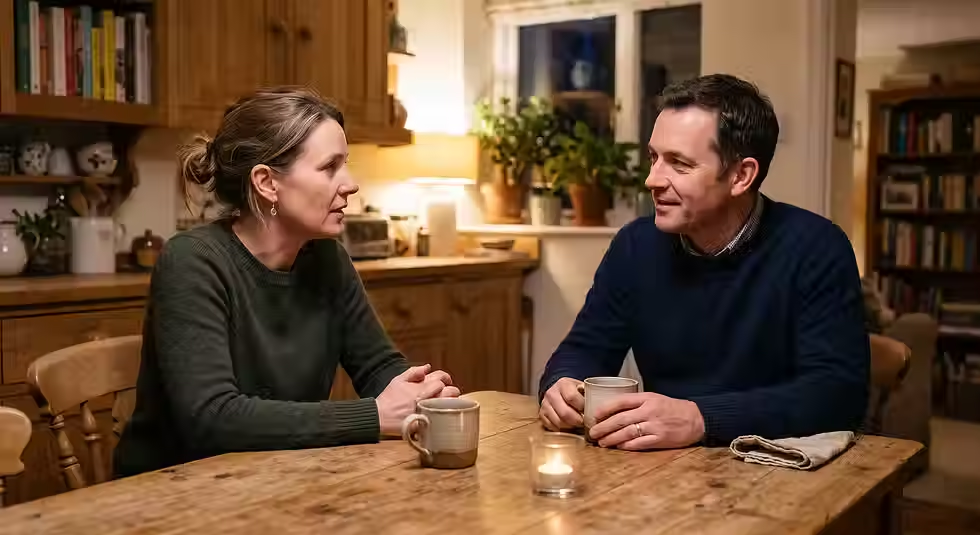
The Shared Human Experience: You Are Not Alone in Your Struggles
Updated: Sep 4

You look around and it seems like everyone else has it figured out. Meanwhile you're carrying anxiety, self-doubt, or a relationship that feels like it's falling apart, and it feels like no one else could possibly understand what that's like.
The shared human experience is the recognition that struggles like anxiety, self-doubt, and grief are common to nearly everyone, not proof that you're uniquely broken. Recognizing that shared reality is often the first step toward real support.
This guide explains what the shared human experience actually means, why isolation feels so convincing even when it isn't true, and how connecting with others changes the course of recovery.
Table of Contents
What Is the Shared Human Experience?
Why It Feels Like You're the Only One Struggling
Struggles Millions of People Share Right Now
Why Sharing Your Struggles Helps You Heal
Finding Strength in Community and Connection
How Chateau Approaches the Shared Human Experience
When to Seek Professional Help
Frequently Asked Questions
What Is the Shared Human Experience?
The shared human experience is the recognition that while your specific circumstances belong to you, the emotions underneath them, like anxiety, grief, shame, and self-doubt, are experiences nearly everyone eventually faces. Psychologists call this concept common humanity, and it's one of the better-researched paths out of isolation.
Feeling like your pain is uniquely yours is common. It's also usually inaccurate. Most people compare their private struggles to everyone else's public presentation, and that comparison almost always favors the other person.
The shared human experience doesn't erase your specific pain. It reframes it. Your struggle connects you to nearly everyone else instead of separating you from them, and that reframe is often the first real step out of isolation.
Why It Feels Like You're the Only One Struggling
Social media makes isolation feel like a fact instead of a feeling. You see curated vacations, promotions, and smiling families, and none of it shows the anxiety attack someone had that morning or the argument they had right before the photo. That gap between what you feel and what you see is what convinces you your struggle is unusual.
It isn't. About a third of U.S. adults experience an anxiety disorder at some point in their life, according to the National Institute of Mental Health. That's not a rare condition. It's one of the most common mental health experiences in the country, and most of the people carrying it look just as put-together as everyone else in your feed.
Comparison is the engine behind this illusion. When you compare your behind-the-scenes struggle to someone else's highlight reel, you lose every time, not because your life is worse, but because the comparison was never fair to begin with. The shared human experience only becomes visible once you stop measuring yourself against a performance.
Struggles Millions of People Share Right Now
Anxiety, self-doubt, relationship strain, and career pressure aren't separate problems. They're the same handful of struggles showing up in different corners of most people's lives, which is exactly what the shared human experience describes.
Anxiety attacks can feel like they're happening to you alone in the moment, but they follow a pattern clinicians see constantly. Low self-esteem tends to develop the same way in different people: repeated comparison, harsh self-talk, and a mistaken belief that everyone else was simply born more confident.
In 2024, 23.4% of U.S. adults, or 61.5 million people, experienced a diagnosable mental illness in the past year, according to SAMHSA's National Survey on Drug Use and Health. Nearly one in four adults around you is managing something close to what you're managing right now.
You're not the exception. You're part of a population-sized pattern, and that pattern has well-studied paths toward relief.
Why Sharing Your Struggles Helps You Heal
Vulnerability gets treated like a weakness, but it works more like a release valve. Naming a struggle out loud, to a friend, a therapist, or a support group, does something isolation never allows: it lets another person confirm the shared human experience for you, in real time, by telling you they've felt this too.
Group therapy works partly because of this exact mechanism. Hearing someone else describe your exact fear, almost word for word, does more to reduce shame than any amount of private reasoning. Shame survives in secrecy. It rarely survives being spoken out loud in a room full of people nodding along.
This is also why so many people delay reaching out. Saying the struggle out loud makes it real. What most people find, once they finally say it, is relief instead of judgment.
Finding Strength in Community and Connection
Connection isn't a soft add-on to recovery. It's a measurable protective factor. About one in two American adults reported feeling lonely even before the pandemic made things worse, according to the U.S. Surgeon General's advisory on social connection, which also found that chronic loneliness carries health risks comparable to smoking daily.
Building resilience rarely happens in isolation. It happens through repeated small moments of being seen: a support group member who nods at the right moment, a friend who says "me too," a family member who stops trying to fix things and just listens instead. Each of those moments is the shared human experience in practice, not just in theory.
If you're not sure where to start building that kind of network, our guide on finding the right mental health support system breaks down the specific types of support most recovery plans need.
How Chateau Approaches the Shared Human Experience
At Chateau Health & Wellness, community isn't an afterthought bolted onto individual therapy. Clients move through treatment inside a 56-bed residential setting with a 1:4 clinician-to-client ratio, so the shared human experience becomes a daily, lived part of care rather than an idea to think about alone.
Chateau's residential programs run 30, 60, or 90 days, and much of the clinical work happens in group settings alongside individual and family sessions. For clients whose anxiety or self-doubt is tangled up with a deeper mental health condition, Chateau's depression and anxiety program integrates psychiatric care into that same peer-connected model.
The goal isn't to convince you your struggle is minor. It's to put you in a room with people who already understand it, so you stop carrying it as if you're the only one.
When to Seek Professional Help
Recognizing the shared human experience behind your struggles doesn't mean you have to manage them without help. If anxiety, low self-esteem, or relationship strain has started affecting your sleep, your work, or your ability to function day to day, that's a sign self-help and casual support have reached their limit. Residential care becomes worth considering when the isolation itself, not just the original stressor, has become the harder problem to treat.
At Chateau Health & Wellness, we provide residential mental health treatment in a private, boutique setting in Utah's Wasatch Mountains.
Frequently Asked Questions
What does the "shared human experience" mean in psychology?
The shared human experience, also called common humanity, is the recognition that painful emotions like grief, shame, and self-doubt are part of being human rather than a personal flaw. Psychologists studying self-compassion have found that recognizing this shared reality reduces isolation and supports emotional healing.
Why does it feel like everyone else has their life together?
Social media and everyday comparison show you other people's curated highlights, never their private struggles. That imbalance creates a false impression that your anxiety, self-doubt, or relationship problems are unusual, when research shows these experiences are widespread and rarely visible from the outside.
How does talking about my struggles actually help me heal?
Speaking a struggle out loud, to a friend, therapist, or support group, reduces the shame that keeps it hidden. Hearing someone else confirm they've felt the same way replaces isolation with the shared human experience, which is one of the most consistent factors linked to better mental health outcomes.
Is feeling isolated a sign I need professional support?
Isolation itself can become a problem separate from whatever caused it. If loneliness or disconnection is affecting your sleep, relationships, or daily functioning alongside your original struggle, that combination is a reasonable signal to talk with a licensed therapist or explore a higher level of care.
What is common humanity, and how is it different from just knowing other people struggle too?
Common humanity is an active recognition that your specific pain connects you to others, not just an abstract fact you accept intellectually. It shifts how you relate to your own struggle in the moment, turning isolation into a felt sense of belonging rather than a passing thought you already knew.
Chateau Health & Wellness provides residential mental health treatment in a private, boutique setting in Utah's Wasatch Mountains. Call (801) 877-1272 or start the admissions process to talk through what supported, community-based care could look like for you.
 |  |  |

About The Author

Zachary Wise is a Recovery Specialist at Chateau Health and Wellness
Where he helps individuals navigate the challenges of mental health and addiction recovery. With firsthand experience overcoming trauma, depression, anxiety, and PTSD, Zach combines over 8 years of professional expertise with personal insight to support lasting healing.
Since 2017, Zach has played a pivotal role at Chateau, working in case management, staff training, and program development.