
How to Stop Negative Self-Talk: 11 Techniques That Actually Work
- Apr 28, 2025
- 6 min read
Updated: 4 days ago

That voice in your head that calls you a failure before you even try? You are not stuck with it. Learning how to stop negative self-talk starts with understanding where that voice comes from and how to talk back to it.
You can stop negative self-talk by naming your inner critic, questioning the evidence behind its claims, and replacing harsh judgments with balanced, specific language you would use with a friend.
Below, you will find where negative self-talk comes from, why it is so hard to shake on your own, and 11 techniques you can start using today.
On this page:
What Is Negative Self-Talk?
Where Does Negative Self-Talk Come From?
How to Stop Negative Self-Talk: 11 Techniques That Actually Work
How Chateau Approaches Negative Self-Talk and Co-Occurring Mental Health
When to Seek Professional Help
Frequently Asked Questions
What Is Negative Self-Talk?
Negative self-talk is the critical inner monologue that judges your abilities, appearance, or worth in harsh, often exaggerated terms. It sounds like "I always mess this up" or "I'm not good enough," even when the evidence does not support it.
Everyone has an inner critic. The problem starts when that critic runs the show. Persistent negative self-talk can limit your thinking, feed perfectionism, and strain your relationships. It pushes you toward black-and-white judgments instead of a fair, accurate read of the situation.
According to the APA Dictionary of Psychology, cognitive restructuring is a technique used in cognitive therapy to help someone identify self-defeating beliefs, refute them, and replace them with more adaptive thinking. That is the clinical foundation behind most of the techniques below.
Negative self-talk is not a character flaw. It is a learned pattern, and learned patterns can be unlearned.
Where Does Negative Self-Talk Come From?
Negative self-talk usually traces back to a handful of habits and experiences, not a single cause.
Unresolved relationship conflict is one driver. When you avoid a hard conversation, the frustration does not disappear. It often turns inward as self-blame. Facing high-stakes situations without preparation or support works the same way, leaving you to fill the gap with self-doubt instead of confidence.
An unchecked inner critic is another common root. If you let every mistake go unquestioned, the critic gets louder and more convincing over time. Comparing your behind-the-scenes life to someone else's highlight reel adds fuel, creating a standard nobody actually meets.
For some people, negative self-talk is also a symptom of an underlying condition such as depression or an anxiety disorder, not just a habit. The National Institute of Mental Health notes that depression can cause severe symptoms affecting how a person feels, thinks, and handles daily activities, and a harsh internal voice is often part of that picture.
Once you can name where the pattern started, it gets easier to interrupt it instead of just reacting to it.
How to Stop Negative Self-Talk: 11 Techniques That Actually Work
You do not have to overhaul your entire mindset overnight. Small, repeated changes in how you respond to your inner critic add up.
Catch the thought. Pay close attention to what your inner critic says and when. You cannot challenge a thought you have not noticed.
Separate thoughts from facts. A thought like "I'm going to fail" is not evidence. It is a prediction your brain generated, and predictions are often wrong.
Name your inner critic. Giving it a name creates distance between you and the voice, which makes it easier to question instead of obey.
Contain it. When a spiral starts, write the thought down or picture setting it aside in a box. This keeps one thought from snowballing into ten.
Swap negativity for neutrality. Instead of "I'm a failure," try "That did not go the way I planned, and I can adjust." Neutral language is easier to believe than forced positivity.
Cross-examine the claim. Ask "Is this actually true?" and "What evidence backs this up?" Most harsh self-judgments fall apart under basic scrutiny.
Talk to yourself like a friend. Ask what you would say to someone you cared about in the same situation, then say that to yourself.
Look for the gray area. Few situations are all good or all bad. Finding the middle ground takes the edge off an all-or-nothing judgment.
Say it out loud. Hearing a thought spoken instead of just felt can expose how extreme it actually sounds.
Try third-person self-talk. A peer-reviewed study from the University of Michigan found that third-person self-talk reduced activation in a brain marker of self-referential emotional reactivity without requiring extra cognitive effort, making it one of the simplest evidence-backed tools available.
Replace it with something specific. Vague positivity rarely sticks. Naming one real accomplishment or one thing you are grateful for gives your brain something concrete to hold onto.
None of these techniques require perfection. Using even two or three consistently is usually enough to loosen the grip of a harsh inner voice.
How Chateau Approaches Negative Self-Talk and Co-Occurring Mental Health
At Chateau Health & Wellness, negative self-talk is treated as a symptom worth investigating, not just a habit to manage. Clinicians use cognitive behavioral therapy to help clients identify the specific cognitive distortions driving their inner critic and replace them with more accurate thinking patterns.
For clients whose self-talk is tangled up with depression, anxiety, or trauma, this work happens inside Chateau's depression and anxiety program, where the 4:1 clinician-to-client ratio allows for real individual attention rather than generic worksheets. Chateau is a 56-bed residential facility for adults 26 and older in Utah's Wasatch Mountains, and treatment always looks at what is underneath the self-talk, not just the words themselves.
Clients often find that skills built through resilience exercises and structured burnout-prevention practices reinforce the same reframing skills taught in individual therapy, creating consistency between sessions and daily life.
When to Seek Professional Help
Self-help techniques work well for everyday negative self-talk, but they are not enough when the inner critic is tied to depression, an anxiety disorder, unresolved trauma, or a pattern of using substances to quiet the noise. If your self-talk has stayed severe for weeks, is paired with hopelessness, or has started affecting your relationships or ability to function, outpatient support may no longer be enough.
At Chateau Health & Wellness, we provide co-occurring mental health and addiction treatment in a private, boutique setting in Utah's Wasatch Mountains.
Frequently Asked Questions
Where does negative self-talk come from?
Negative self-talk often develops from unresolved relationship conflict, an unchecked inner critic, or comparing yourself to others. It can also be a symptom of an underlying condition such as depression or anxiety, which is why a pattern that will not budge is worth mentioning to a clinician.
How can positive affirmations help with negative self-talk?
Positive affirmations work best when they are specific and believable, not vague. Naming one real strength, accomplishment, or piece of evidence gives your brain something concrete to counter the inner critic with, which builds lasting confidence more effectively than generic, repeated phrases ever manage to.
What is one effective technique for challenging negative thoughts?
Cross-examining your inner critic works well. Ask yourself, "Is this really true?" or "What evidence actually supports this belief?" Most negative self-talk cannot survive that kind of scrutiny once you write it down, which makes it far easier to replace with a balanced, accurate thought.
How does negative self-talk affect relationships?
When you believe you are not good enough, it becomes harder to trust others, set healthy boundaries, or stay emotionally open. Left unaddressed, this pattern can also contribute to unhealthy coping behaviors, including substance use, as a way to quiet the criticism.
When does negative self-talk require professional treatment?
If negative self-talk persists for weeks, comes with hopelessness, or is tied to depression, anxiety, trauma, or substance use, self-help strategies alone are often not enough. A licensed clinician can identify the underlying driver and build a treatment plan around it.
Chateau Health & Wellness treats negative self-talk as part of a larger clinical picture, especially when it is tangled up with depression, anxiety, or addiction. Chateau's admissions team offers a complimentary, confidential assessment to help you figure out the right level of care. Call (801) 877-1272 to talk with someone today.
 |  |  |

About The Author
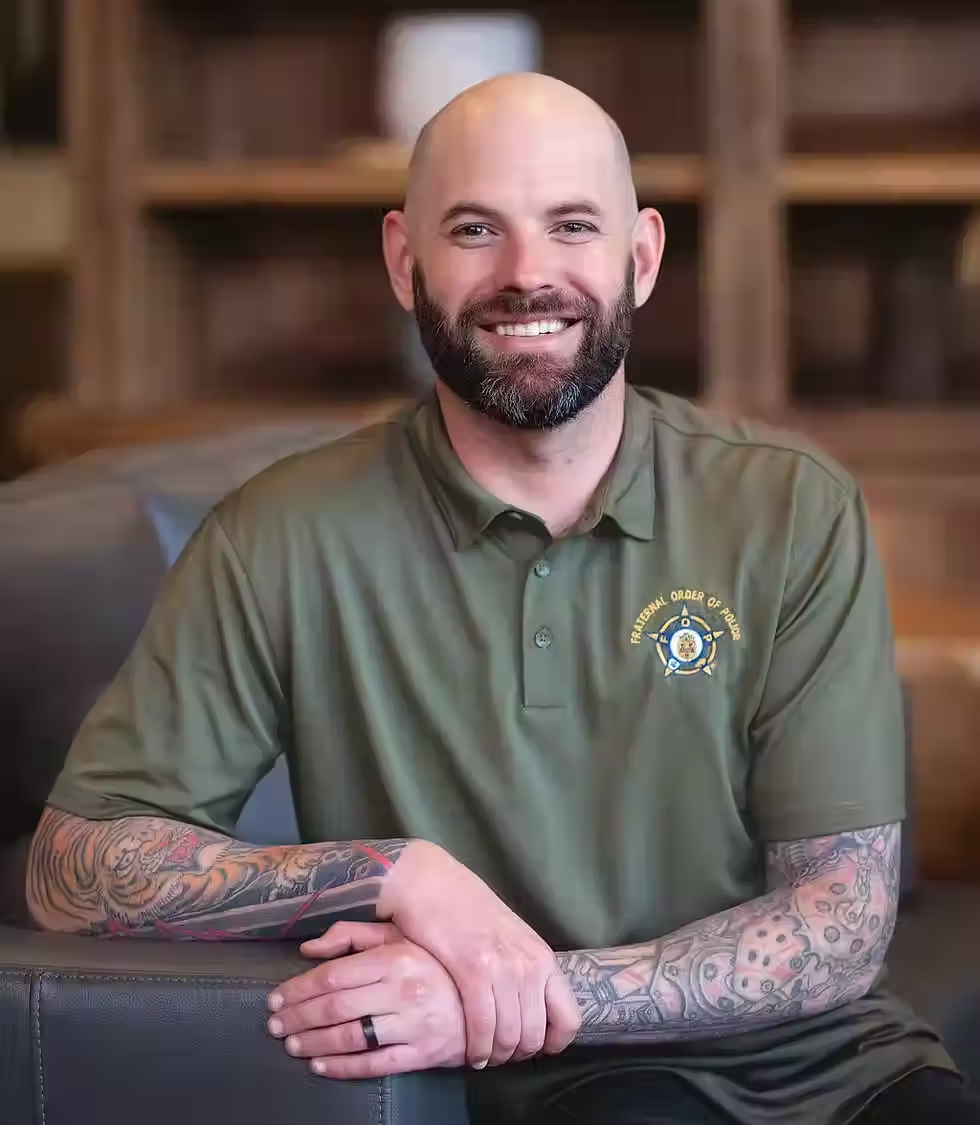
Austin Pederson, Executive Director of Chateau Health and Wellness
Brings over eight years of experience revolutionizing mental health and substance abuse treatment through compassionate care and innovative business strategies. Inspired by his own recovery journey, Austin has developed impactful programs tailored to individuals facing trauma and stress while fostering comprehensive support systems that prioritize holistic wellness. His empathetic leadership extends to educating and assisting families, ensuring lasting recovery for clients and their loved ones.


