How to Take Care of Yourself When Your Loved One Is an Addict
Updated: Sep 26

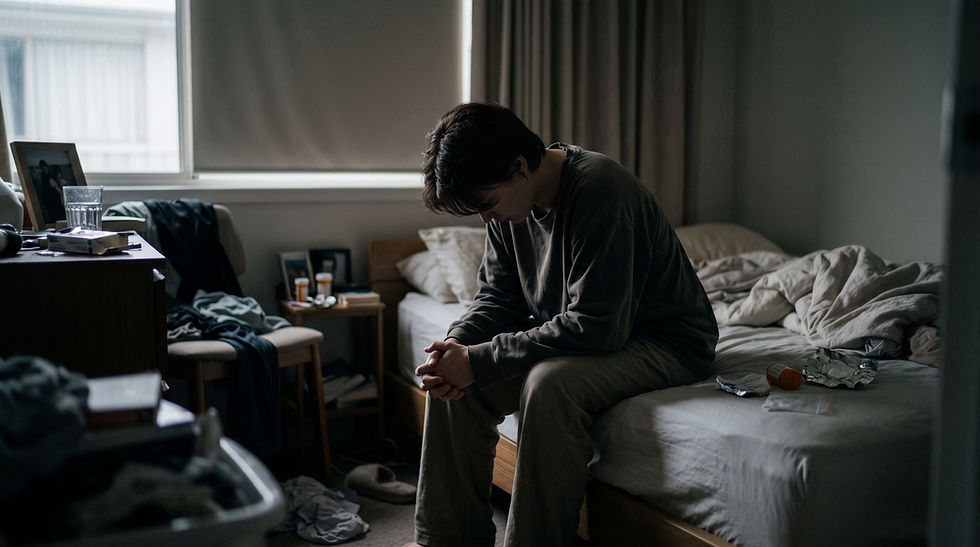
If you've searched for how to take care of yourself when your loved one is an addict, you already know how much energy managing someone else's addiction can quietly take from you. Living with someone who is addicted to drugs or alcohol wears you down in ways that are hard to explain to anyone who hasn't been through it. You watch someone you love spiral, and somewhere along the way, your own needs slide to the bottom of the list.
Self-care for family members of an addict means protecting your physical, mental, emotional, and spiritual health with boundaries and support, not stepping back from love, but stepping out of the chaos so you can stay steady.
This guide breaks down what real self-care looks like in each of those four areas, how to set boundaries without drowning in guilt, and where to find support built specifically for families living with addiction.
In this article:
Why Self-Care Isn't Selfish When Someone You Love Is an Addict
The Four Types of Self-Care Every Family Member Needs
Setting Boundaries Without Guilt
Enabling vs. Helping: How to Tell the Difference
Finding Support: Al-Anon, Nar-Anon, and Family Therapy
How Chateau Approaches Family Wellness
When to Seek Professional Help
Frequently Asked Questions
What It Means to Take Care of Yourself When Your Loved One Is an Addict
Addiction is often called a family disease, and that's not just a figure of speech. According to the Substance Abuse and Mental Health Services Administration's most recent survey, 48.7 million people aged 12 and older had a substance use disorder in the past year, and each one of those cases ripples out to parents, partners, siblings, and children. A University of Michigan study published in the Journal of Addiction Medicine found that nearly 17 million children in the U.S. live with a parent who has a substance use disorder.
If you're managing someone else's addiction, you're probably doing more than you realize. Covering for them. Making excuses to their boss. Searching the house for hidden bottles or pills. Losing sleep over what might happen next. This is exhausting work, and it's work that goes almost entirely unnoticed by everyone except you.
Here's the part that surprises most people: the better you take care of yourself, the more capacity you actually have to help the person you love. Chateau's family systems approach to recovery is built around this idea. A family functions as one connected system, and when one member is running on empty, the whole system suffers, including the person struggling with addiction.
Self-care isn't a reward you earn once the crisis is over. It's the thing that keeps you upright while the crisis is still happening.
The Four Types of Self-Care Every Family Member Needs
Self-care gets a bad reputation as bubble baths and spa days. For families living with addiction, it means something more specific. There are four areas that need attention, and neglecting any one of them tends to catch up with you.
Physical self-care starts with the basics: eating regular meals, drinking enough water, sleeping, and moving your body. Chronic stress from living with active addiction can cause real physical illness over time, so keep up with annual checkups and dental visits even when they feel like one more thing on the list. If there is any physical violence in your home, from hitting or throwing objects to forced substance use, that is not something to manage through self-care alone. Leave, call the police, and seek a restraining order if advised.
Mental self-care means noticing when your thoughts are stuck on a loop. Al-Anon's literature describes this well: constantly counting drinks, searching for hidden bottles, listening for the sound of a can opening. This kind of hypervigilance has a name (compassion fatigue), and it builds the same way physical exhaustion does. Redirecting your attention back to your own career, hobbies, or a new skill isn't avoidance. It's how you protect your own mind.
Emotional self-care matters most when there's verbal or emotional abuse involved, whether it comes from the addicted person or from the self-blame that often creeps in on its own. Emotional abuse is not something to tolerate as part of the deal. Individual counseling, a support group, or simply journaling can give those feelings somewhere safe to go instead of piling up.
Spiritual self-care is often the hardest and the most important. It starts with genuinely accepting that you did not cause your loved one's addiction, you cannot control it, and you cannot cure it. That doesn't mean giving up. It means redirecting your energy toward what is actually within your power: yourself.
Every family living with addiction needs attention in all four of these areas. Skipping one usually shows up as burnout in another.
Setting Boundaries Without Guilt
Boundaries are the practical tool that makes the four types of self-care possible. Without them, self-care stays theoretical.
A boundary is not a punishment or an ultimatum. It's a clear statement of what you will and won't accept, followed by consistent action. "I will not have conversations with you when you've been drinking. If you call while drinking, I will hang up," is a boundary. "I need you to stop drinking" is not. One is something you control. The other isn't.
Start small. Pick one behavior that's affecting your wellbeing, state the boundary calmly using "I" language, and follow through the first time it's tested. Expect pushback. Guilt trips ("you don't love me anymore"), minimizing ("it's not that bad"), and promises ("this is the last time") are common responses. The boundary holds regardless of the response, because it was never about controlling the other person's behavior. It's about protecting yours.
This is sometimes called detachment with love: staying emotionally connected to someone without absorbing every consequence of their addiction. It's one of the most repeated concepts in Al-Anon rooms for a reason. It works, even though it rarely feels comfortable at first.
Enabling vs. Helping: How to Tell the Difference
Most family members of an addict aren't trying to make things worse. They're trying to help, and often that help crosses into enabling without anyone noticing.
Helping supports the person's actual recovery: driving them to a meeting, going with them to an appointment, or simply listening without judgment. Enabling removes the natural consequences of their use: paying off their debts, calling in sick for them, or telling their family everything is fine when it isn't.
The tricky part is that enabling almost always looks like love in the moment. It feels wrong to let someone face a consequence you could have prevented. But shielding someone from consequences also removes their motivation to change. Chateau's guide on creating caring boundaries around codependency breaks down the specific patterns to watch for, including excessive worry, feeling responsible for someone else's choices, and difficulty saying no.
If you recognize your own behavior in the description of enabling above, that's not a failure. It's simply the starting point for learning a different way to support the person you love.
Finding Support: Al-Anon, Nar-Anon, and Family Therapy
You don't have to figure this out on your own, and trying to is part of what leads to burnout. Al-Anon and Nar-Anon are free, widely available peer support groups built specifically for people whose loved ones struggle with alcohol or drug use. Meetings happen in person and online, and there's no cost or membership requirement to attend.
Individual counseling gives you a private space to work through guilt, anger, and grief that may not feel appropriate to bring into a family setting. Family therapy sessions go a step further, giving the whole family a structured way to communicate, rebuild trust, and stop unhealthy patterns like triangulation, where conflict between two people gets redirected onto a third.
A research trial funded by the National Institute on Alcohol Abuse and Alcoholism found that a structured, family-focused approach succeeded in getting a treatment-refusing loved one into care 64% of the time, compared to 30% for a traditional confrontational intervention and just 13% for standard Al-Anon counseling alone. Structured support for families isn't a side note. It's one of the most effective tools available for getting someone into treatment in the first place.
How Chateau Approaches Family Wellness During a Loved One's Recovery
At Chateau Health & Wellness, families are treated as part of the recovery process, not bystanders to it. Chateau's Family Support Program gives loved ones education, guidance, and structured tools while their family member is in residential care, so both sides arrive at the end of treatment with a shared plan instead of the same unresolved patterns.
Chateau's 56-bed residential program in Utah's Wasatch Mountains treats adults 26 and older with
a staffing model with one staff member for every four clients in small, dedicated groups, giving each client (and by extension, each family) more individualized clinical attention than most standard programs. Family involvement throughout treatment is built into the program from admission through discharge planning, not added on as an afterthought.
When to Seek Professional Help
Self-care, boundaries, and a support group like Al-Anon can carry a family a long way. But there's a point where informal coping isn't enough anymore: when abuse enters the home, when your own mental health is deteriorating, or when your loved one's addiction has reached a level where detox or residential treatment is medically necessary. If you're constantly in crisis mode and nothing you try is holding, that's the signal to bring in professional support, both for your loved one and for yourself.
At Chateau Health & Wellness, we provide residential addiction treatment alongside a structured family support program for the loved ones walking through this with them.
Frequently Asked Questions
What is the best way to help a loved one with addiction?
The most effective first step is to take care of yourself. Family members who set boundaries, get their own support, and stop managing the addiction's daily chaos give their loved one room to feel real consequences, which is often what motivates someone to finally accept treatment.
What are the four types of self-care for family members of an addict?
The four types are physical, mental, emotional, and spiritual self-care. Physical care covers sleep, nutrition, and medical checkups. Mental care means redirecting obsessive thoughts back to your own life. Emotional care means processing abuse or guilt safely. Spiritual care means accepting what you cannot control, cause, or cure.
How do I set boundaries with an addicted loved one without feeling guilty?
Guilt is common and does not mean the boundary is wrong. Start small, state the boundary calmly using "I" language, and follow through consistently. Support from a therapist or a group like Al-Anon helps you hold the line when guilt or pushback show up.
What is the difference between enabling and helping an addict?
Helping supports a person's recovery, like driving them to a meeting. Enabling removes the natural consequences of use, like paying their bills or making excuses to their employer. Enabling feels caring in the moment but keeps the addiction comfortable and delays change.
Where can family members of addicts find support and counseling?
Al-Anon and Nar-Anon offer free peer support meetings specifically for families. Individual counseling, family therapy, and structured family programs at a residential treatment center also give loved ones tools to cope, set boundaries, and heal alongside the person in recovery.
Chateau Health & Wellness offers a structured family support program for loved ones dealing with a family member's addiction, alongside residential treatment for the person who needs it. Call (801) 877-1272 or reach out to the admissions team to talk about what support looks like for your family.
 |  |  |

About The Author

Ben Pearson, LCSW - Clinical Director
With 19 years of experience, Ben Pearson specializes in adolescent and family therapy, de-escalation, and high-risk interventions. As a former Clinical Director of an intensive outpatient program, he played a key role in clinical interventions and group therapy. With 15+ years in wilderness treatment and over a decade as a clinician, Ben has helped countless individuals and families navigate mental health and recovery challenges.